
Blog Details
- Member
- February 25, 2026
Problem Partitioning A Proprietary Framework for Disciplined Strategic Evolution
**Srijan Sanchar Problem Partitioning A Proprietary Framework for Disciplined Strategic Evolution**
In an era of accelerating technological change, compressed innovation cycles, and pervasive uncertainty, organizations and institutions face a persistent paradox: generative abundance has eliminated scarcity of ideas and scenarios, yet discernment, coherence, and constraint-preserving convergence have become the true bottlenecks. Traditional foresight methods oscillate between narrative speculation that lacks structural rigor and retrospective analytics that cannot meaningfully guide intentional transformation. Optimization approaches preserve short-term feasibility but rarely accommodate systemic evolution under deep uncertainty. Meanwhile, the rise of large-scale generative models has amplified the volume of possibilities without a corresponding increase in the reliability of outcomes. Against this background, Srijan Sanchar has developed **Srijan Sanchar Problem Partitioning** — a proprietary internal framework designed to enable high-stakes actors to navigate complexity with disciplined judgment rather than speculative volume.
Srijan Sanchar Prakriya is positioned as a meta-architecture for intentional system evolution. It is not a forecasting tool, nor a classical optimization engine, nor a scenario-generation exercise. Instead, it functions as a disciplined reasoning scaffold that transforms high-dimensional ambiguity into structured, auditable, and recombinable decision intelligence. The framework integrates cognitive hygiene, causal architecture, probabilistic anticipation, and directional design into a single, repeatable process that remains grounded in verifiable boundaries — physical, economic, ecological, ethical, and computational. Its purpose is to ensure that long-horizon strategic choices are simultaneously ambitious in direction and defensible in construction, even when certainty is low and consequences are high.
The breakthrough embedded in Srijan Sanchar Problem Partitioning lies in its ability to convert what is normally treated as an intractable, holistic problem into a lattice of small, high-integrity reasoning units that can be solved with precision and then reassembled without loss of structural coherence. This shift — from macro-narrative dominance to micro-verified orchestration — allows the framework to maintain constraint integrity, reduce abstraction drift, and produce outputs that are far more robust to real-world shocks than conventional methods. It reframes the central challenge of contemporary strategy from “generating more options” to “constructing fewer but far more reliable evolutionary pathways.”
Two extended applications of the framework — one addressing the reduction of pollution from heavy-duty trucks through electrification pathways (battery-dominant vs. overhead catenary), and the other focused on raising average freight speed on Indian Railways by tackling terminal detention — yielded several rare insights that conventional macro-level analyses consistently miss or under-weight.
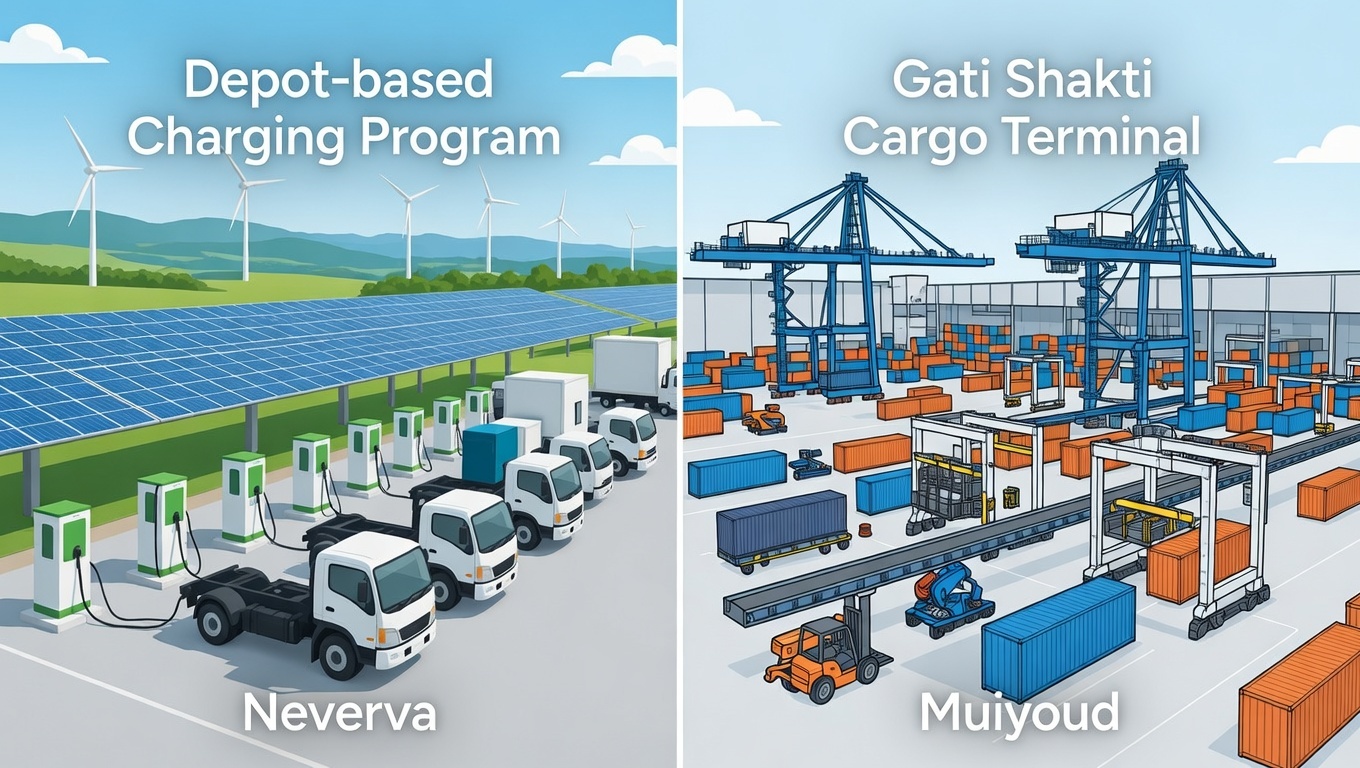
In the truck electrification case, the framework surfaced that depot-based charging combined with renewable power purchase agreements represents a disproportionately robust “no-regret” move — not because it solves the entire long-haul problem, but because it simultaneously attacks the highest-sensitivity economic barrier (charging cost share in TCO), delivers controllable grid impact, achieves high utilization economics, and avoids premature technology lock-in. This insight only became visible when the charging infrastructure barrier itself was broken into orthogonal sub-components rather than treated as a monolithic “infrastructure gap”. The analysis also revealed that overhead catenary systems, while theoretically attractive for heavy long-haul on fixed corridors, carry hidden fragility in the form of route rigidity and multi-decade capital commitment — fragility that macro studies rarely quantify with the same sharpness.
In the Indian Railways freight terminal efficiency case, the method exposed that the dominant leverage point is not further yard remodelling or signaling upgrades (frequently emphasized in policy documents), but the aggressive scaling of mechanized Gati Shakti Cargo Terminals (GCTs) coupled with streamlined private siding incentives. This combination delivers asymmetric gains in wagon turnaround time (30–50% detention reduction in mechanized facilities) and does so with far lower systemic risk than attempting to mechanize legacy sheds at national scale. The decomposition also clarified that private sidings function as a force-multiplier precisely because they shift utilization risk to private actors while preserving public infrastructure throughput — an incentive-alignment dynamic that aggregate-level planning almost never captures.
Both cases demonstrated that when a problem is approached through disciplined micro-verification rather than aggregated narrative, the resulting directional vectors become narrower, more robust, and more institutionally adoptable. The framework does not eliminate uncertainty; it changes how one evolves within it — from speculative breadth to constrained, verifiable depth.